_edited.png)


.png)
In 2022 I had the priveledge of taking on one tough physical challenge, every month. I called it my 12x12 : a self-imposed physical challenge to test my limits, learn more about my nervous system and challenge my core beliefs. I chose challenges that would test me both physically and mentally. I also chose challenges that I 'feared' . I firmly believe that the only path to true happiness and success is through self awareness. When you are in an uncomfortable environment, there is nowhere to hide. Your thoughts become clear, your patterns become visible, and you are forced to confront the stories you are telling yourself. Only then can you do the work to re-wire your thought processes.
The 12 × 12 Challenge
A Year of Endurance and Self-Discovery
Twelve months. Twelve challenges. A journey into fear, endurance, and self-discovery.
_edited.jpg)


The Everesting concept is brutally simple: repeat a climb until the total elevation equals
the height of Mount Everest — 8848 metres.
My challenge was to climb the 50-metre Westcliff Steps again and again until the
accumulated elevation reached Everest.
That meant:
-
177 ascents
-
177 descents
-
About 65 km of climbing and descending
-
No sleep
I started at 06:00 on Saturday morning. Through the heat, rain, darkness, and early
morning light, the only way forward was simple: one step at a time.
One repetition became two.
Two became ten.
Ten became fifty.
Morning became afternoon. Afternoon became night.
Eventually the sun set — and later rose again.
During the long hours I learnt to trust my body and understand the signals of pain
and fatigue. Pain was inevitable, but it was not mysterious. The challenge was physical,
but also deeply mental.
I was supported by an incredible group of friends, helpers, and visitors who came throughout
the day and night to climb the stairs with me and offer encouragement.
After 28 hours and 4 minutes, I completed the 177th ascent.
This challenge also raised R12,000 to sponsor Omphile Motaung, a young cyclist, to participate
in Race2Willowmore, a Freedom Challenge mountain bike event that formed part of my
March challenge.
Everesting – Westcliff Steps, Johannesburg
8848m total ascent
Completed in 28 hours and 4 minutes
_edited.jpg)
Dusi Canoe Marathon
17–21 February 2022
Completed – despite the canoe breaking in half

The Dusi Canoe Marathon is one of South Africa’s most iconic
river races: roughly 120 km over three days, from Pietermaritzburg
to Durban, navigating rapids, portages, and unpredictable river conditions.
There was just one complication: I had never paddled before.
I began learning only a few months earlier, knowing full well that many
experienced paddlers warned that the Dusi is not a race for novices.
I was fortunate to paddle with Themba Ngcobo, a development paddling
coach from the Umzinyathi Canoe Club. Between the two of us, it is hard
to say who was more nervous.
We started the race dressed as Superman. I often use imagery as a mental
tool during challenges. I don’t believe I am Superman, of course — but the
symbol reminds me of strength, possibility, and resilience. In difficult moments,
small psychological cues like this can help shift how the brain interprets stress and fatigue.
The first two days went reasonably well, despite a few unexpected swims in the
rapids. In truth, parts of the river were frightening.
On the final day our luck ran out. Our canoe became trapped on rocks and
wrapped around them, snapping the boat in half. One half disappeared into
the river — along with my paddle.
But the race was not over.
Themba and I dragged what remained of the canoe along the road towards
Durban. For roughly 30 km we pulled the broken boat behind us until we
eventually crossed the finish line.
We finished last, but we finished — and received our medals.
_edited.jpg)
March
Part 1:
Race to Cradock MTB Race
March 2022
Completed in 3 days and 7 hours (79 hours)

The Race to Cradock is a 580 km non-stop mountain bike race from Rhodes
to Cradock, involving approximately 8,300 metres of climbing. It forms part of
the Freedom Challenge series and is known for its remote terrain, difficult
navigation, and long hours of riding through the night.
Navigation is part of the challenge. Riders are not allowed to use GPS
and must follow the route using only a map, narrative description, and
compass. For someone like me — with a questionable sense of direction
— this adds a healthy dose of anxiety to the event.
I had completed the race before, so I knew what to expect. This time my
goal was ambitious: to break the women’s course record of 60 hours and 8 minutes.
That did not happen.
I finished in 79 hours. That's 3 days and 7 hours. But not 2 days and 12 hours and 7minutes.
While the rain and mud certainly slowed things down, the honest truth is that I simply was
not trained well enough to truly race the event.
Endurance racing has a way of stripping away illusion. It reveals strengths and
limitations very clearly — and, in my case, occasionally reveals that I have taken a wrong turn.
Tough physical challenges also reveal uncomfortable truths about our expectations
and limitations. These are not failures. Learning to accept those realities without losing
self-respect is an important part of understanding how the mind works under pressure.
_edited.jpg)
March
Part 2
Race to Willowmore MTB Race
March 2022

Just three days after finishing the Race to Cradock, I lined up for
the Race to Willowmore, a 530 km, 7000m ascent, non-stop mountain bike race
from Cradock to Willowmore.
This time I was joined by Omphile Motaung, a 25-year-old cyclist
from Bloemfontein, who was taking part in her first Freedom Challenge
event.
Together we rode across remote terrain, navigating the route using only
maps, route narratives, and a compass — GPS devices are not allowed in
Freedom Challenge races.
Omphile made history during this event, becoming the first black
woman to ride a Freedom Challenge race. She approached the
challenge with remarkable courage, determination, and humour.
One day on the route we had to cross a fast-flowing river eleven times.
Only later did Omphile casually mention that she did not actually know how to swim.
Moments like this remind me how powerful courage and determination can
be when people are given the opportunity to step into new environments.
After completing the race, I invited Omphile to join me in my June
challenge, the Freedom Challenge Race Across South Africa (RASA)
— a 2,200 km race from Pietermaritzburg to Paarl.
To help make that possible, I planned to use my May challenge,
The Hour Endurance Challenge — to raise funds for her entry.
Challenges like this are never only about physical endurance.
They reveal courage, vulnerability, and the power of support,
all of which shape how the mind responds to uncertainty and difficulty.
_edited.jpg)
Iron Man Triathlon
Port Elizabeth
11H40min

The Ironman took place just five days after finishing the Race to Willowmore,
which meant there was very little time for the body and mind to recover.
An Ironman normally consists of three disciplines:
-
3.8 km swim
-
180 km cycle
-
42 km run
Unfortunately, the swim was cancelled due to rough weather and unsafe
sea conditions.
The cycling leg was challenging. Heavy rain and a strong headwind made for slow
and difficult riding, and tackling the course on my modified mountain bike certainly
did not make things easier.
The run was, as expected, demanding. The course consisted of a 7 km loop
repeated several times, and what made it manageable was the incredible
support along the route. The encouragement from spectators and fellow
competitors helped carry me through the tougher moments.
The final 20 km were particularly difficult. Fatigue had set in deeply and I had
to draw on my mental reserves, taking energy from the supporters lining the course.
I crossed the finish line in 11 hours and 40 minutes.
It meant a great deal to have my mom there supporting me throughout the day.
She is a true inspiration.
At 88 years old she lives independently and approaches life with resilience and
determination. Seeing her there reminded me that I come from strong
and resilient heritage, especially women.
Running repeated 7 km laps when you are already tired is mentally demanding.
Each time you pass the same point you see athletes who are ahead of you and
have already completed more laps. At the same time, you see others who are
just starting while you have been running for hours.
It quickly becomes clear that endurance is not only physical — it is deeply mental.
Everyone is in some form of a “pain cave”: a community united by a common
challenge. Simply knowing that others are experiencing the same struggle
somehow makes it more manageable.
Small strategies help.
Singing a song in your head.
Thinking about people who are less fortunate and feeling gratitude.
Seeing the same smiling faces along the course each lap.
Catching sight of my mom cheering on the sidelines.
And sometimes reminding myself of something very simple:
I chose to do this.
Knowing that the challenge was voluntary changes how the mind interprets
the discomfort.
This was not something being done to me — it was something
I had chosen to attempt.
And eventually, like all things, it would end.
So you keep moving.
One foot in front of the other.
In moments like this, endurance becomes less about physical ability and more
about the mindset we bring to the challenge.

The Hour Endurance Challenge
Cow Shed
Pretoria
61 hours, 610km.

_edited.jpg)
The Hour Endurance challenge involved cycling 10km on the hour every hour, for 60 hours, or until the last person was left standing. I found this challenge to be really hard, especially the night sections as I only had about 15min every hour to eat and sleep. It was also very cold lying on a thin matrass on a cement floor in an open dairy shed. The event music played continuously through the day and night, so I hardly slept. I did do a lot of thinking. This is the benefit of time spent in the endurance zone. I found myself trying to process the many questions and doubts lurking in the recesses of my brain. Soul searching will always bring your deepest desires, emotions and insecurities to the surface.
I did complain a lot. I often threatened to quit. Luckily, I have learned that my complaining and need to give up is just a side-effect of the emotional detox process. Fortunately, some of my close friends and family know me well. When I complain and threaten to stop they just nod and say: “Yes, I know it is hard, but if you quit, you fail’. Their 'tactics' always seem to work as I did finish my 60 hours. After 60 hours (600km) there were only two women left in the woman’s event: me and Elaine Beytell. This meant we had to race a sudden death lap; the winner takes all. I really did try my best on that last lap, but Elaine was just too fast, a worthy winner. I would not have managed to complete 61 hours if I did not have the support of my friends and family; they kept me going through some dark hours.
I managed to raise funds for Omphile Motaung, a 25- year-old woman from Bloemfontein, to ride in the Freedom Challenge Race Across South Africa (RASA), with me in June 2022. This is an extreme MTB race from Pietermaritzburg to Paarl. This will be the first time that a black woman has ridden in this event.

.jpg)
_edited.jpg)
June, July: The Freedom Challenge Extreme Triathlon
3 extreme events back-to-back
.png)
Many years ago, David Waddilove, founder of the Freedom Challenge,
set in motion the idea of an Extreme Triathlon: completing three demanding
endurance events in succession. Run the Comrades from Durban to Pietermarizburg.
The next day get on your MTB and do the Freedom Challenge, Race Across South
Africa from PMB to Paarl. Then on arrival in Paarl, start the 4 day Berg Canoe Marathon from Paarl to Veldrif. Basically a self propelled journey across South Africa from East to West.
In 2022 I set out to attempt this extraordinary sequence.
The journey began on 12 June, when I ran the Comrades Marathon route
— approximately 90 km from Durban City Hall to Pietermaritzburg City Hall.
Because the official Comrades had moved to May that year, I ran the route alone. I
completed the run in 11 hours and 30 minutes, and for good measure ran 100 km.
The very next day, 13 June, I lined up to start the Freedom Challenge Race
Across South Africa (RASA) — a 2,200 km self-navigated mountain bike race
from Pietermaritzburg to Paarl.
For this event I was joined by Omphile Motaung . I was delighted to ride alongside
Omphile and support her through her first ever RASA.
Twenty-one days later we arrived in Paarl after an extraordinary journey across
mountains, valleys, rivers, and remote terrain.
Omphile became the first black woman to complete the full Freedom Challenge
RASA. She showed incredible determination and resilience throughout the ride.
.jpg)


Omphile Motaung
Two days after finishing RASA with Omphile I started the Berg River Canoe Marathon. This is a four day, technical paddle, from Paarl to Veldrif. I knew from the beginning that this would be one of the most intimidating challenges for me.

The Berg River Canoe Marathon
240km over four days from Paarl to Velddrif.

One of the challenges I set for myself during my 12x12 year was the Berg River Canoe Marathon.
I knew going in that this would probably be the toughest challenge of them all.
Not because of fitness. Because I was new to paddling.
The Berg is not a gentle introduction to river paddling. It is technical, unpredictable, and demands real river proficiency. Because I didn’t yet have that experience, I was allowed to paddle in my own K1 canoe, but had to have a chaperone paddling alongside me.
David Waddilove kindly agreed to escort me on my first Berg. This was all arranged at the last minute, and I remain deeply grateful to him for offering his time, experience, and calm presence on the river.
Day One 61km
The first day was difficult but manageable. I fell into the freezing water five times. I lost two paddles. Each swim was a reminder that the river does not care about your plans, your training, or your intentions. You simply deal with what the river gives you.
Day Two 56km
The second day was far more technical. Tree blockages forced difficult manoeuvres, and my lack of river experience became increasingly obvious.
I swam repeatedly in the icy water. At one point I became completely tangled in a tree block. The canoe, paddle, branches, and even the cord attached to my hat were wrapped around me. For nearly thirty minutes I was stuck in the river trying to untangle myself. Eventually I had to let go of the paddle just to free myself.
That moment stripped away any illusion of control.
When Fear Takes Over
As the day progressed it became clear that we were not going to complete the 56 km stage before dark. By then I was also becoming severely cold and struggling to think clearly. Hypothermia was setting in. Continuing would have been unsafe.
We made the decision to abandon the race.
The Emotional Fallout
I was disappointed. Embarrassed. Mortified. I felt like a fraud. I felt that I had let David down. I questioned my judgment as a mother, an athlete, and a person attempting something that perhaps I had no business attempting.
What Fear Taught Me
But that experience taught me something profound about fear.
Fear is not weakness. Fear is information. Fear is the nervous system responding to a situation where the demands exceed the available skills.
Without the right tools, experience, and training, fear quickly becomes overwhelming. But when competence grows, fear changes.
It becomes something you can work with rather than something that controls you.
The lesson was clear:
Confidence does not come from belief. It comes from skill, preparation, and experience. The nervous system needs evidence before it allows calm.
That race did not end the way I hoped. But it taught me more about fear and the nervous system than any success could have.
And that, in many ways, was the real purpose of the challenge.

13 Peaks Challenge
Table Mountain Nature Reserve, Cape Town
110km, 38 hours non-stop
.jpg)
This was a 110 km non-stop challenge involving running, walking, and
hiking across Table Mountain.
The goal was to tag (visit) all 13 peaks of Table Mountain. The challenge was
initiated by South African trail runner Ryan Sandes. It is not an official race,
but rather a personal challenge where participants attempt to complete the
route as quickly as possible and record their time as a Fastest Known Time (FKT).
On 21 August, I took on this challenge with two remarkable women: Erica Terblanche
and Simone Sharpe. Together we completed the route in under 38 hours.
I only met Erica on the morning of the challenge. We had chatted on the phone and
she kindly offered to guide us on the mountain. Erica has enormous experience
running on Table Mountain and shared her knowledge generously throughout the
journey. Erica is an extraordinary athlete who has run — and won — numerous
ultra-distance races across deserts around the world.
I met Simone the day before the challenge when she arrived at my house.
Although we had spoken on WhatsApp, we had never officially met in person.
Simone is a cancer survivor who has also overcome a life-threatening blood disease.
Her gratitude and love of life is infectious.
Simone was relatively new to endurance events, but she had a deep appreciation
for her body and what it was capable of achieving.
Together we moved across the mountain for nearly two days — sharing stories,
laughter, fatigue, and moments of quiet determination.
This challenge was particularly difficult for Simone. She was new to the realities
of extreme endurance — the sleep deprivation, the relentless ascents and descents,
and the emotional highs and lows that come with moving through the night on
the mountain.
One of the peaks on the route is Constantiaberg, overlooking the Constantia valley.
For Simone, this peak carried a much deeper meaning.
As a teenager she spent many days receiving cancer treatment at Constantiaberg
Mediclinic, often looking up at the mountain, from her hospital bed.
In the early hours of 22 August, around 5:30 am, Simone stood on that very peak
and looked down at the hospital where she had once been a patient. A true Fuck
You Cancer moment.
It was a deeply emotional moment.
She cried. We cried.
Towards the end of the journey she was in considerable pain from severe blisters,
and sore knees, but she kept moving forward with determination.
Together, we finished the challenge.
Spending nearly two days moving across the mountain creates space for
reflection. Fatigue, discomfort, and uncertainty slowly strip away the noise
of everyday life. What remains is something simple: the rhythm of movement,
the presence of others, and the quiet dialogue inside your own mind.
Challenges like this reveal how strongly the mind influences what the body
believes it can do. When the body is tired, the brain often tries to protect us
by suggesting that we stop. Learning to recognise those signals —
and gently continue anyway — is part of understanding how the nervous system
responds to stress and uncertainty.
On the mountain, progress often comes down to something very simple:
one step, one ridge, one peak at a time.
.png)
.jpg)


100km Indoor Concept2 rowing ergometer
Johannesburg
9 hours 22 min

For my September challenge I decided to row 100 km on an indoor Concept2 rowing
ergometer.
I knew from the start that this was going to be a tough challenge. My bum and lower
back were always going to be the biggest obstacles. Unlike cycling, where you can lift
yourself off the saddle occasionally, rowing offers very little pressure relief.
After many hours on the ergometer it became a real test of vasbyt — that uniquely
South African combination of stubborn determination and perseverance.
In the end it became a lesson in mind over matter.
Being able to chat to friends throughout the challenge was a wonderful distraction
from the discomfort and helped the time pass more easily. Plus a whole pile of pillows
under my bum.
Rowing is actually a fantastic full-body workout, and I can highly recommend it —
although perhaps not for 100 km.
If I ever start talking about rowing across the Atlantic Ocean, please remind me
about the bum pain… or at the very least suggest investing in a very good cushion.
Challenge completed in 9 hours and 22 minutes.


Robben Island is known around the world as the place where
Nelson Mandela, South Africa’s first democratically elected president,
was imprisoned for 18 of his 27 years in jail. The island has since become
a powerful symbol of the triumph of democracy and freedom over
oppression, and a testament to the resilience of the human spirit.
The Robben Island open-water swim is an iconic South African challenge,
swimming from Robben Island to Big Bay Beach in Bloubergstrand. The
distance typically ranges between 7.4 km and 11 km, depending on the sea
currents — and on one’s ability to swim in a straight line.
I, for one, do not swim straight.
On 18 October, a beautiful calm day, I was joined by seven remarkable women
to take on this challenge:
Veronica Todd, Erica Terblanche, Leanne Webster, Simone Sharpe, Robyn Cowley,
Abigail Avidon, and Sheila-Ann Tobey.
We were ably supported by Derrick Frazer (Big Bay Events) and his team, with two
swimmers per support boat.
The swim was spectacular and a tremendous success. These brave women set aside
their fears and gave the challenge their very best effort.
Women are beautiful.
Women are also tough and powerful.
We hope that our unity and shared experience will inspire and encourage other women
to discover their own inner strength and resilience.
October is also Breast Cancer Awareness Month, and our swim was used to raise
awareness and funds for the “I Love Boobies” campaign — an NGO that provides free
breast examinations to South African women who cannot access these services due
to financial, geographic, or social barriers.
Thank you to everyone who supported and donated.
Swimming in the open ocean can be intimidating.
The water is cold. The distance is long. And the depth beneath you can trigger
very real fear.
Yet we did it.
Seven women supporting one another, each facing her own doubts and
fears, and choosing to keep swimming.
Together we reached the shore.
Robben Island Open- Water -Swim


Drakensberg Grand Traverse (DGT)
210 km • ~8,000 m ascent • Non-stop
100 hour cut-off

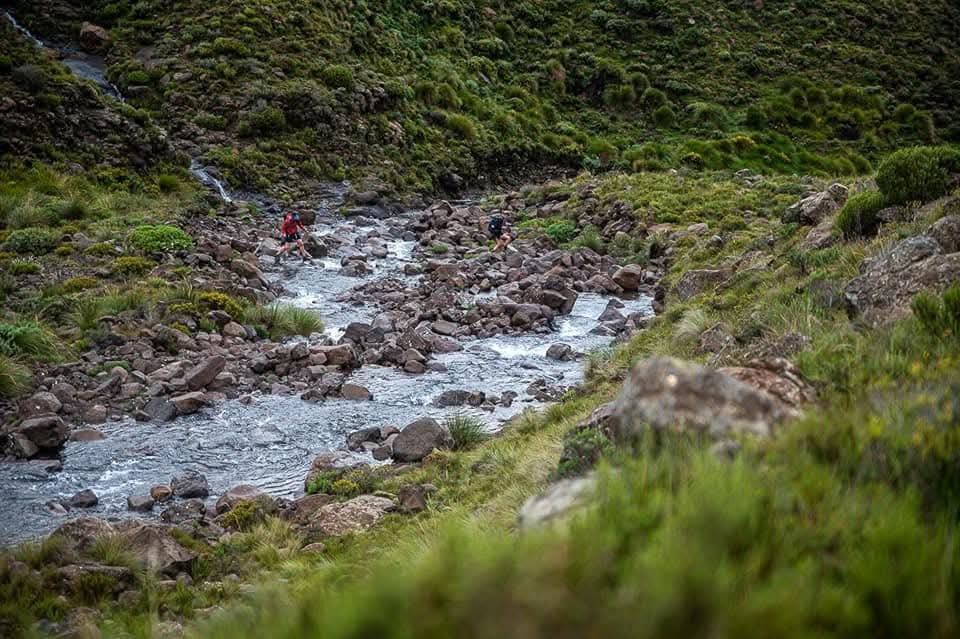
The Drakensberg Grand Traverse (DGT) is a 210 km single-stage mountain run
across the Drakensberg range that forms the border between South
Africa and Lesotho.
Participants must travel self-sufficiently and self-navigated, tagging several
iconic Drakensberg peaks along the way. The route involves approximately 8,000
metres of climbing, high altitude exposure, rugged terrain, and extreme weather
conditions.
The race has a 100-hour cut-off, and competitors must carry their own food,
clothing, and minimal sleeping gear.
This was a paired event, and I was joined by Erica Terblanche for this crazy
adventure.
The weather was not particularly kind. We experienced rain, sleet, hail, mist, freezing
temperatures, and occasionally even a bit of sunshine.
We gave it our best effort but unfortunately missed the cut-off at Leslie’s Pass,
roughly 80 km into the challenge.
Despite not finishing, we learned many valuable lessons.
Route navigation is absolutely critical — even when using a GPS. A GPS is perhaps
70% reliable, which is manageable during the day but far more difficult at night.
We also discovered that we both now require reading glasses to properly interpret
maps and navigation notes.
And we learned something else: the mountains can get brutally cold. The correct gear,
while expensive, is essential.
(Note to self: a black garbage bag is not an adequate waterproof layer.)
Success in the DGT ultimately comes down to one fundamental principle: time
in the mountains.
Recce the route.
Explore the terrain.
Test your equipment.
Acclimatise to the altitude .
In other words, pay your school fees.
The Dragon, as beautiful as she is, is also a fiery beast. She has laid down
a serious challenge.
We will most certainly be back. We will return to once again worship at her feet.
What a privilege it is to have your butt kicked by such a magnificent temptress.


The Jo’burg to Blouberg 1000-Miler is an epic, self-supported cycling journey
covering approximately 1,600 km, mostly on gravel roads, from Vereeniging
(south of Johannesburg) to Blouberg Beach in Cape Town, finishing with the
spectacular view of Table Mountain. The concept is simple: carry your own stuff,
and stop when you want to stop.
The route follows the Massive Adventures Jo’burg to Blouberg 1000 Mile
Cycle Route, beginning at Three Rivers on the southern outskirts of Johannesburg
and ending roughly 1,000 miles later at the Atlantic Ocean.
I rode this adventure with Omphile Motaung.
What an adventure it was.
Along the way we battled mud, flooded rivers, intense heat, and even an exploding
front tyre. Despite navigating with a GPS, we still managed to get lost at
one point — a small mistake that added an extra day of riding to our journey.
The final days were particularly demanding: headwinds, heat, deep sand, and
endless corrugations. Crossing Ou Berg Pass and riding through the Tankwa Karoo
reminded us that this landscape is both beautiful and unforgiving — a place to be
respected.
Eventually we rolled into Blouberg on Wednesday evening. 6 days and 5 hours.
Two women.
Two mothers.
Two friends.
Throughout the journey we were reminded that, despite the challenges
our country faces, South Africa is a spectacular place.
Even more remarkable are her people.
Although we rode unsupported, we were welcomed along the route with kindness,
admiration, and generosity.
We felt safe everywhere we travelled.
I wish that every woman in South Africa could experience that same sense
of freedom.
Women hold up half the sky, yet we are often made to feel irresponsible for
seeking adventure or embracing independence. Perhaps we were lucky.
I prefer to believe we were fortunate and blessed.
December
1000 miler (1600km) gravel ride
Johannesburg to Cape Town
Self- supported
6 days, 5 hrs
